
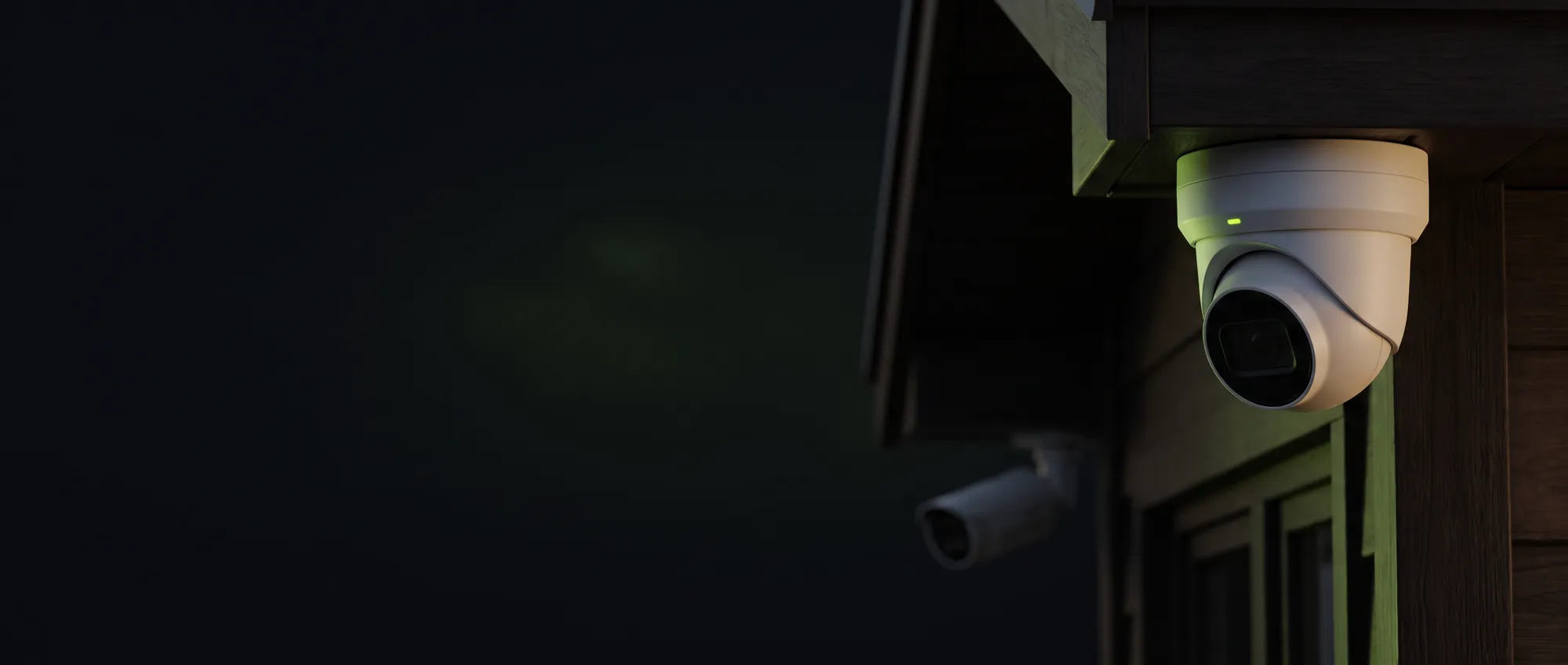
Home CCTV: how to choose the right system
IP cameras, DVRs, NVRs, resolution and night vision: everything you need to know to protect your home with a CCTV system.
Why fit a CCTV system
Home security is a priority for every family. A CCTV system does not only record an intrusion, it works above all as a deterrent: visible cameras alone sharply reduce the risk of burglary and vandalism. Statistics suggest homes with CCTV are around 60% less likely to be broken into.
Technology has made CCTV affordable for everyone, both in price and in how complicated it is to install. Complex cabling and expensive control units are no longer needed: with modern IP and wireless cameras you can protect a whole house for a modest outlay and watch everything from your phone, wherever you are.
Analogue or IP cameras: which to choose
Analogue cameras, connected to a DVR over coaxial cable, are the traditional technology. They are cheap and reliable, but resolution is limited (generally up to 2 MP) and each camera needs its own cable. They are still a reasonable choice for small systems where image quality is not the top priority.
IP cameras, connected to an NVR over Ethernet or Wi-Fi, are today's standard. They offer resolutions up to 4K (8 MP), advanced features such as person and vehicle recognition, two-way audio and push notifications to your phone. Cabling is simpler because a single Ethernet cable carries both video and power (PoE). At Techno Easy we always recommend IP systems for new installations.
If you would rather avoid cables altogether, there are excellent Wi-Fi options with rechargeable-battery or solar-powered cameras. They are ideal for spots where cabling is difficult: gates, detached garages, outbuildings. We install and configure these systems across the whole province of Enna.
How many cameras, and where to put them
The number depends on the size of the property and the access points to cover. For a standard flat or house we suggest a minimum of four cameras: one on the front door, one at the back, one on the gate or drive, and a wide view covering the garden or the perimeter. Larger houses or properties with several entrances need six to eight.
Placement is crucial: cameras should go at least 2.5-3 metres up to prevent tampering, with a field of view that covers the critical points and leaves no blind spots. Every outdoor camera should be IP67-rated to withstand rain, dust and temperature swings. During the free site visit we offer in Leonforte and across the province of Enna, we map every weak point and design the system around it.
Night vision and resolution: what really counts
Most break-ins happen at night, so night vision is not optional. Modern cameras offer two kinds: infrared (IR), which gives black-and-white images at up to 30-50 metres, and colour night vision (ColorVu/Starlight), which uses advanced sensors and extra LEDs to deliver colour images even in very low light.
On resolution, 2 MP (1080p Full HD) is the sensible minimum for a home system. At 4 MP you get far more detail, such as number plates and faces at a distance. 4K (8 MP) is ideal for wide-angle cameras covering large areas, since you can zoom in digitally without losing sharpness. Our quotes always state the resolution we recommend for each position.
Recording and remote access: DVR, NVR and cloud
The recorder — a DVR for analogue, an NVR for IP — is the heart of the system: it takes the video streams, writes them to a hard disk and lets you play them back. We recommend a surveillance-grade hard disk (such as WD Purple) of at least 2 TB, which gives roughly 15-20 days of continuous recording with four 2 MP cameras.
Remote access from a phone is now standard. With the apps from the main manufacturers (Hikvision, Dahua, Reolink) you can watch live, review recordings, get motion alerts and even speak through the cameras with two-way audio. We set all of this up during installation, including remote access on your phone and your family's.
The law and privacy: what the rules say
Fitting cameras at your own home is legal in Italy, but there are rules. Cameras must not film public space (roads, pavements) or a neighbour's property. If the angle unavoidably takes in part of a public area, you must mask the parts that are not yours — a feature available on every modern IP camera.
You are required to display a sign warning that the area is under video surveillance. Systems in a block of flats need a resolution from the residents' meeting. At Techno Easy we handle the legal side too: during installation we configure the masking and supply GDPR-compliant signage. For a free site visit around Leonforte, Enna and nearby towns, get in touch with no obligation.
Need a hand?
Come and see us at either of our shops in Leonforte or Catenanuova, or get in touch for a free quote.
Get in touch